

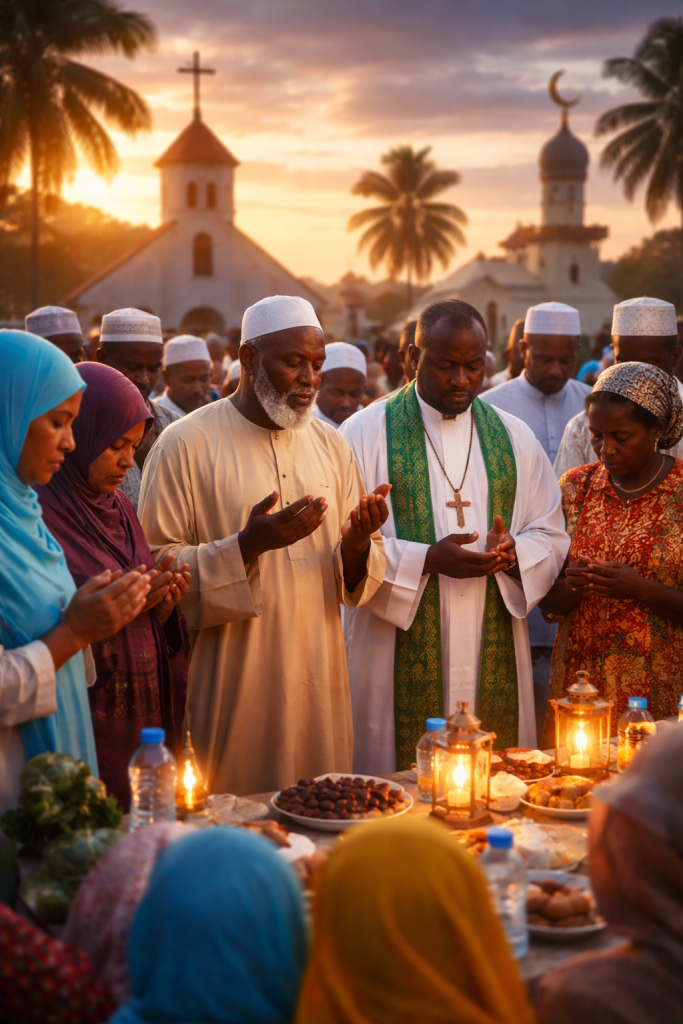
Across Africa — and especially in Tanzania — moments when Christian and Muslim fasting seasons overlap carry deep spiritual, cultural, and social meaning. When the holy month of Ramadan aligns with the Christian season of Lent, it becomes more than a calendar coincidence. It becomes a symbol of unity, reflection, and shared devotion.
Although Islam and Christianity follow different religious calendars — the Islamic lunar calendar and the Gregorian calendar — there are years when Ramadan and Lent intersect. When that happens, millions of Africans find themselves fasting, praying, and seeking spiritual growth at the same time.
A Shared Spirit of Discipline and Devotion
Ramadan is a month when Muslims fast from dawn to sunset, focusing on prayer, charity, self-control, and strengthening their relationship with God. Lent, observed by many Christians for 40 days leading up to Easter, is also a period of fasting, repentance, sacrifice, and spiritual renewal.
While the practices differ, the foundation is similar:
- Self-discipline
- Prayer and repentance
- Charity and generosity
- Reflection and spiritual growth
In Tanzania — a country known for its religious harmony — this overlap creates a powerful atmosphere. In homes, workplaces, and communities, both Christians and Muslims are intentionally drawing closer to God.
Tanzania’s Example of Religious Coexistence
Tanzania has long been recognized as one of Africa’s most peaceful examples of religious coexistence. Christians and Muslims live side by side, often within the same families. When fasting seasons overlap, it deepens mutual respect.
You may find:
- Christian neighbors adjusting schedules to respect Muslim friends breaking fast at sunset.
- Muslims acknowledging Christian friends attending evening church services.
- Interfaith Iftar dinners and shared community meals.
- Increased acts of charity that benefit everyone, regardless of faith.
In cities like Dar es Salaam, Arusha, and Mwanza, this shared spiritual season often strengthens community bonds rather than dividing them.
A Reminder of Common Values
When both faiths fast together, it reminds society of something powerful: despite theological differences, the core values of compassion, humility, and accountability before God are shared.
Fasting strips life down to simplicity. Hunger softens the heart. Prayer clears the mind. Charity strengthens the community.
In Africa — where faith plays a central role in daily life — this overlap often leads to:
- Increased generosity toward the poor
- Greater patience and forgiveness
- Heightened awareness of moral responsibility
- A visible culture of prayer
Beyond Religion: A Social Impact
This shared fasting period can also influence national mood and civic life. Leaders often call for unity, peace, and reflection. Media outlets encourage dialogue. Religious institutions collaborate on charity drives.
In a continent sometimes portrayed through the lens of conflict, moments like these tell a different story — one of coexistence and shared humanity.
A Symbol for the Future
When Ramadan and Lent fall in the same month, it is not about blending religions. It is about respecting difference while recognizing shared devotion to God.
For Tanzania and much of Africa, this alignment becomes a symbol:
- Unity without uniformity
- Faith without division
- Diversity without conflict
It reminds us that even with different paths, communities can walk side by side.
As millions bow in prayer — some facing Mecca, others kneeling in churches — the message is clear: spiritual growth, humility, and compassion are universal values.
And in a world often divided by belief, that shared month of fasting may be one of Africa’s quiet but powerful testimonies to peace.
By The Tanzanian

 The Tanzanian Times