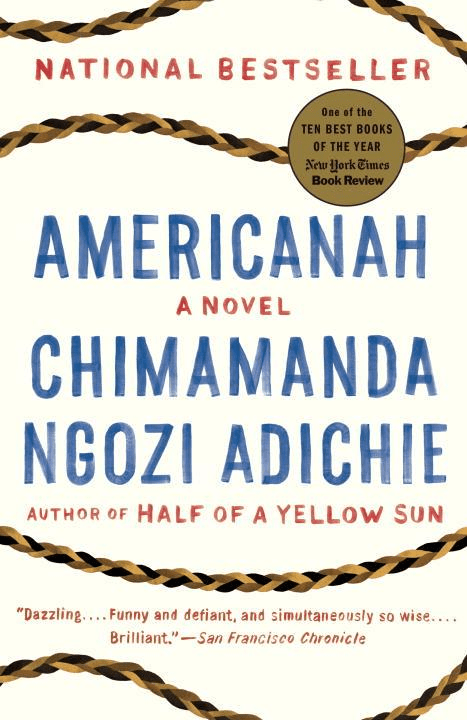
Americanah by Chimamanda Ngozi Adichie

This magnificent books starts of in America where a young Nigerian Woman, Ifemelu decides to go back to Nigeria after living ten years in America. She describes her stay there “ it’s wonderful but it’s not heaven”.

 Ifemelu in her stay in America, realizes that there are indeed racial issues and they do affect her because of the color of her skin color. It was hard for her to get a job though she had graduated from university. For instance, a restaurant tells her that they’ve decided to hire “‘a more qualified person’” for their hostess position or a babysitting job is given to someone else without any explanation.

Racism is not something she never had to deal with back in Nigeria. As she explains to someone at a dinner party,“I came from a country where race was not an issue; I did not think of myself as black and I only became black when I came to America.”

  The author addresses on issues concerning race in America with the character of Ifemelu and her blog addressing the “onyinbos”(white people) on how to treat black people.  For instance “ Dear American Non-Black, if an American Black person is telling you about an experience about being black, please do not eagerly bring up examples from your own life. Don’t say “It’s just like when I …”


Ifemelu grew up in Lagos, Nigeria where she met her highschool sweetheart Obinze. The two went to university together, however due to the political issues in that era, there were strikes and the university shut down. Ifemelu got an opportunity to apply for a scholarship in a university in Philadelphia, America and she manages to get the scholarship and visa while Obinze remained in Nigeria. This is the other side of Americanah where the author tells the story of the persevering love between the two characters across three continents

 In America, Ifemelu is introduced to the American culture and its racial politics. Since Ifemelu couldn’t find a job,She later accepts a job helping a tennis coach “relax.” He touches her sexually and gives her $100. Ifemelu goes home and feels guilty and depressed. She breaks off contact with Obinze. This is were the lovers relationship starts to drift away.

 Obinze is hurt by Ifemelu’s sudden silence. He graduates and moves to England. He stays with friends but can’t find a good job. Obinze borrows money from Emenike, an old friend who has gotten rich in England, and pays for a green-card marriage with a girl named Cleotilde. On the day of his wedding, though, Obinze is arrested and sent back to Nigeria.

 Meanwhile, Ifemelu in America, starts dating a rich, handsome white man. He  takes Ifemelu on many trips and helps her get a good job and a green card. However Ifemelu, feeling the pressure of her interracial relationship, cheats on Curt and he breaks up with her. She gets depressed again. Ifemelu starts her race blog and it gets very popular.

 For more gripping suspense, I suggest you get yourself the book and read. As a reader, I loved the book very much. I loved how Ifemelu and Obinze’s story begun and ended. To the moment where Ifemelu is back in Nigeria in the car with Obinze listening to “Yori yori” by bracket, the reader cannot help but fall in love and see the true meaning of “what’s meant for you will come back to you”

By Vanessa Mwingira

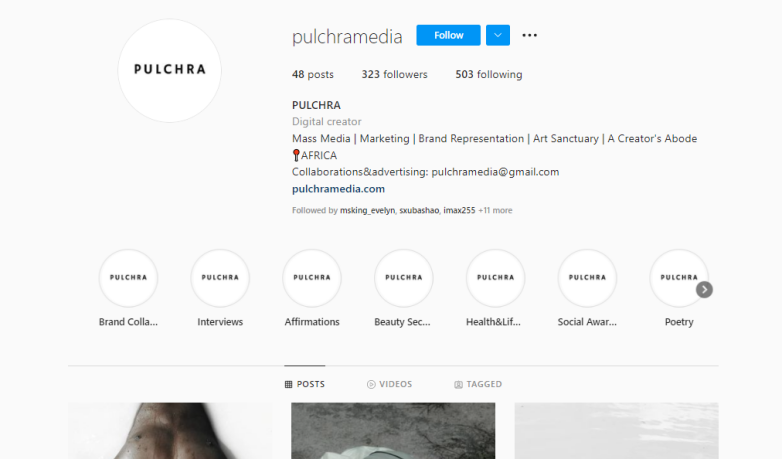
A CREATOR ABODE: PULCHRA MEDIA

There are not many platforms that are available for micro and nano influencers, creators or artists in general. Platforms that encourage, support and celebrate creativity in Africa. Our artists aspire and work tirelessly to be acknowledged and celebrated in foreign lands, which should not be the case, not when we have the resources in our backyard. Pulchra Media is a small scale website and movement that was created to remedy just that. A problem that the Pulchra team realized exists, and quite frankly, could be easily solved.

 Introducing Pulchra Media…A Creator’s Abode

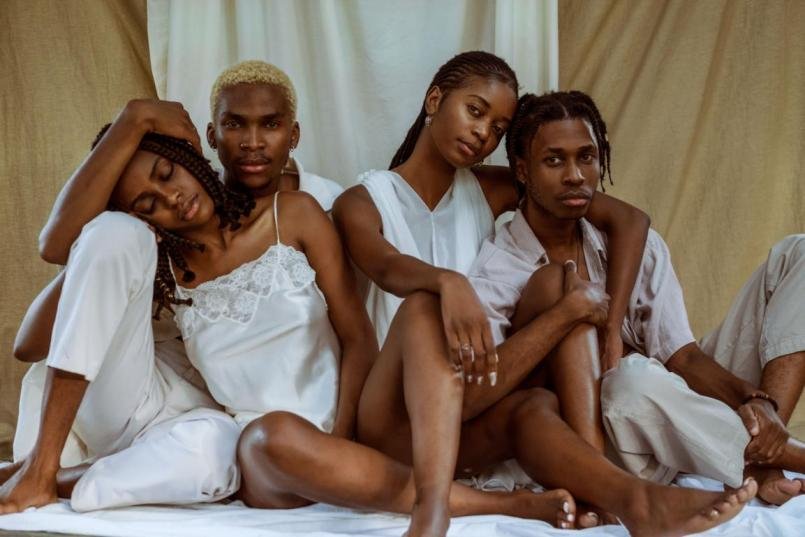
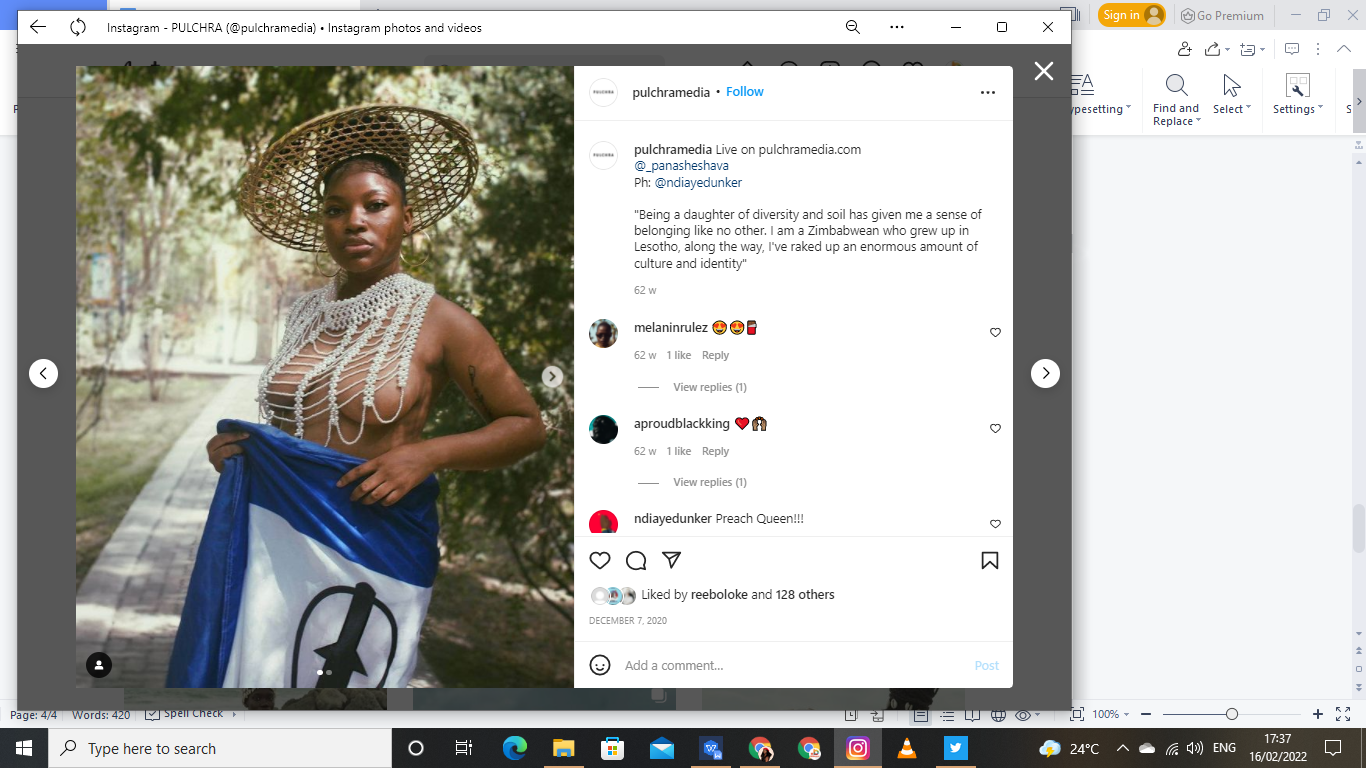
 PULCHRA is a black owned media company and platform that intends to produce content celebrating young, innovative artists and visionaries on a digital platform. This media company fully utilizes this generations favourite tool; social media, to show case brilliance that has been captured and is yet to be captured on a global scale. More than anything, the aim is to invoke healthy and meaningful conversations surrounding the beauty and uniqueness of art that is created by niche and micro creators who are not celebrated enough. 

 The Pulchra team is spearheaded by 4 individuals from all around the continent. 

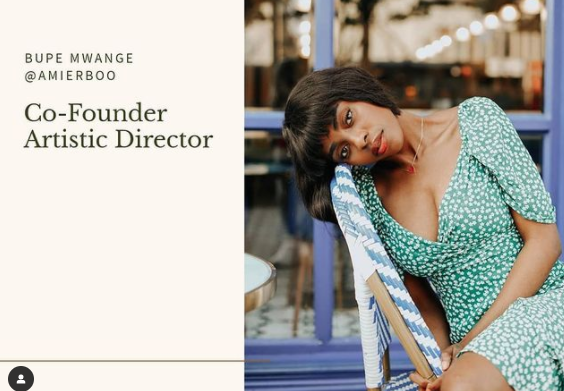
 All the way from Zambia, Bupe Mwange is the Co-Founder and Creative Director of the Pulchra platform. Bupe has proven to be passionate about fashion, which plays an enormous role for the  Pulchra entity.

 Tanzanian photographer , Filly, plays the role of Graphics Consultant. Filly has a very successful photography portfolio having shot festivals, events and cultural embodiments of art. Having such a diverse portfolio is crucial for Pulchra.

 Also Tanzanian , is Ibrahim, the entity’s PR Consultant, based all the way in Maryland, USA. With a vast amount of connections, Ibrahim is solely in charge of client networking and brand growth for the platform.

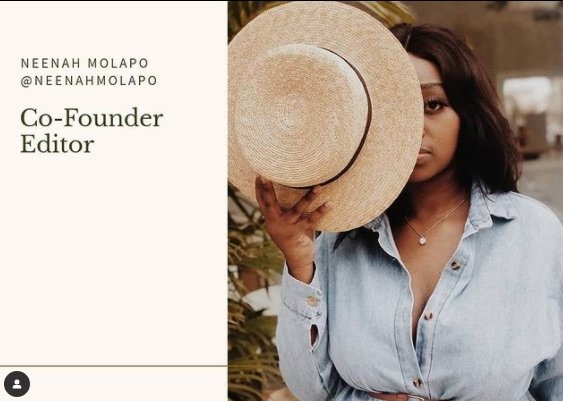
 Also part of the team, is Co-Founder and Editor, Neenah Molapo, all the way from Lesotho. Over the years, she developed a passion for art and digital media and saw to it that a project that embodies all these aspects must be established.

With a clear vision behind Pulchra , they say they hope to take every single one of the members of their audience on a journey of giving every creator their flowers while they can still receive them. “It is more than a promotional activity, but more of a convenient resource and platform that users can turn to for information, education and familiarization of any kind.”

The name PULCHRA has been derived from the word pulchritudinous, which directly means beautiful. Every piece of art, every creation, every item that will be shared on the platform represents just that-beauty. Beauty with substance, beauty that educates, beauty that encourages interactions and beauty that merges and brings us together.

Written By Diile Neenah Molapo

Healthy Outlook On Contemporary Arts

There is no standard way of referring to art. It ranges from modern paintings, to photography, sculptures and dates decades back to oil and silk screenings, and popularly; wax paintings. The manner in which people express themselves has not been celebrated enough in Africa. A plethora of creators spent time in more Western and European settings, therefore, some lose their roots, or are unable to achieve pieces that celebrate the Africa that flows in their blood as constant and as loudly as the Nile flows through the North into the Mediterranean. We have succumb to viewing the pieces created by those among us as inadequate or as needing a western feel, instead of emphasizing and putting a stamp on the fact that this is who we are and that this is our culture.

Innovative visionaries in our continent live and breathe creating content. Each day, we look past artists on accessible platforms, but wait for them to be acknowledged by international press before we put them on a pedestal. Captured brilliance deserves to be laminated and published with pride because our culture and creations should not have to be approved by anyone but us. Thus, the title of this article; invoking a healthy outlook on contemporary art. With 54 countries in our continent, there are waves of content for us to blissfully drown in, and not have to consume any other creations.

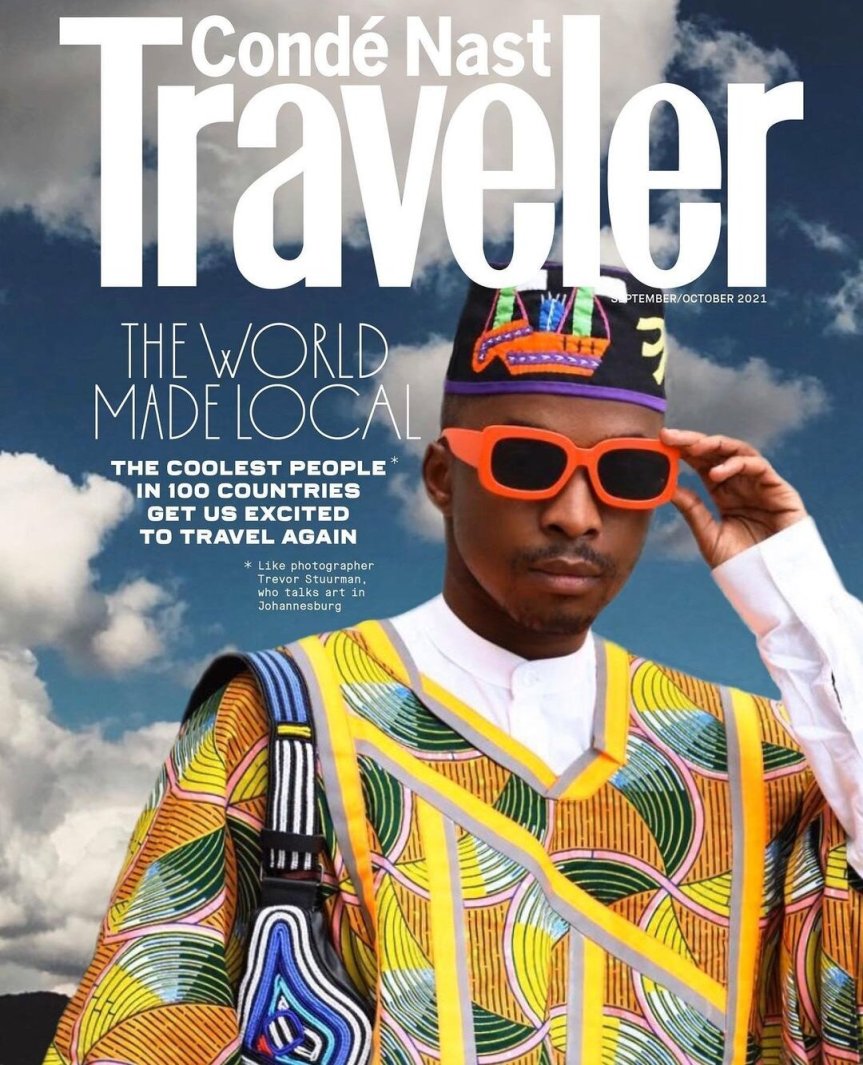
The multiple tribes and cultures in our nation result in a plethora of social differences. These differences are what make us unique. We possess the ability to create strides of beauty more diverse than most can come up with. These diversifications are a result of beauty as far West as Ghana, up from the North, across central towards the East and Tanzania, and finally in the enclave that is Lesotho, in the South. Artists whose presence we must amplify are the likes of Trevor Stuurman, who started in South Africa and remained true to himself and his art, and finally made it on the international marketing, penetrating the global sphere. Trevor has worked with brands ranging from Conde Nast, the well acclaimed media company that has Vogue and CN Traveller under its belt. His creations and collaborations have been featured in most publications and he has gained a large following from this. Locally, he has worked with the brand Maxhosa, which is also racking up accolades as they go in Africa. Local collaborations among artists must be encouraged for each of our nurturing’s to grow.

@paulboypaul_

Courtesy of Paul Gugulethu

The talent in our mother land is more than abundant. May we continue create and may we soar higher while maintaining African art positivity!

Written By Dille Neenah Molapo

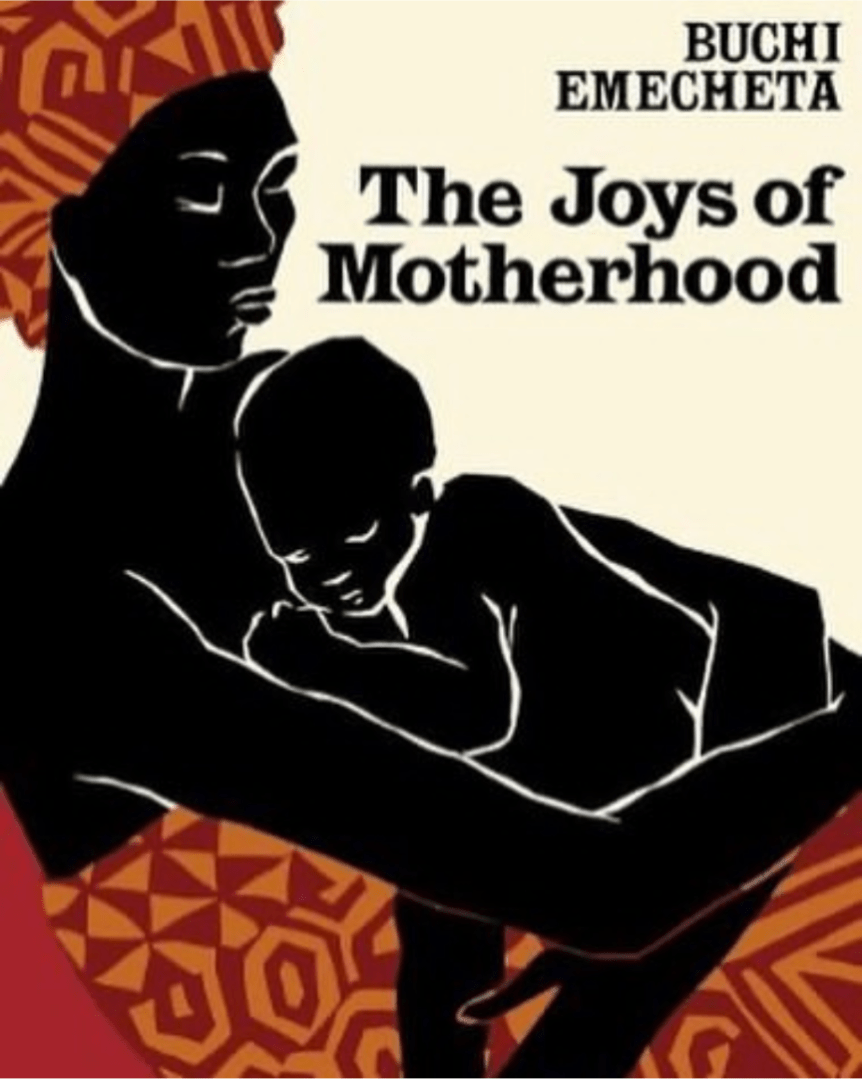
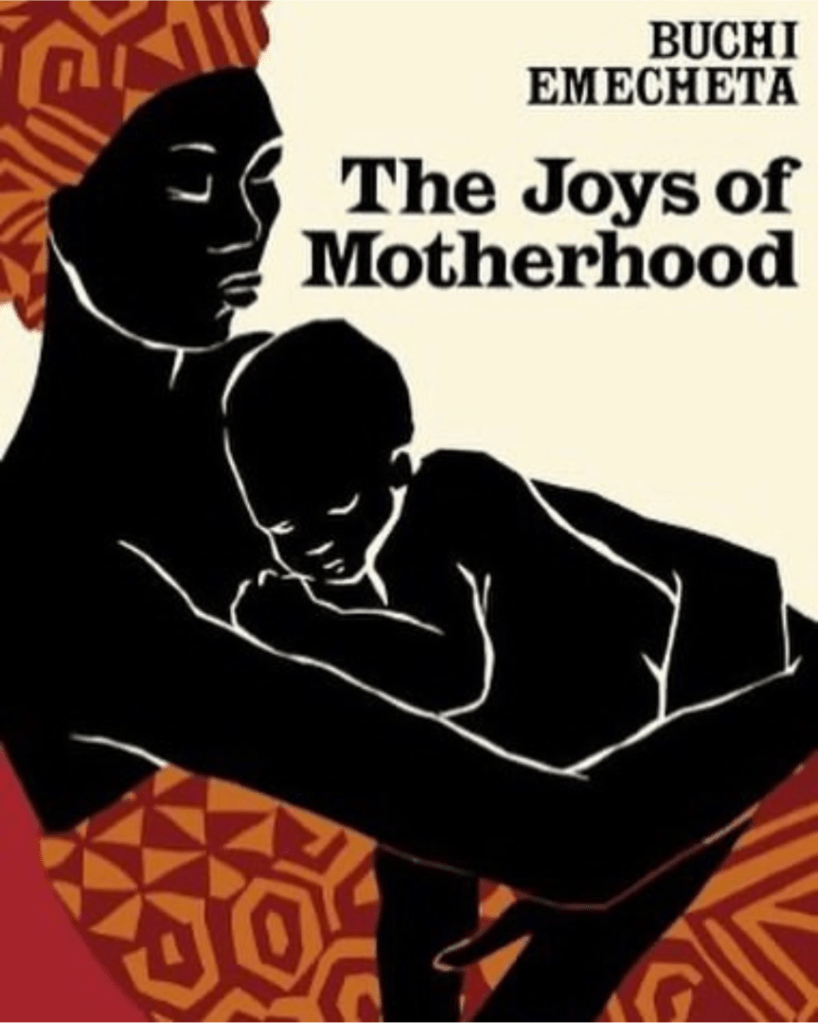
BOOK REVIEW: THE JOYS OF THE MOTHERHOOD BY BUCHI EMECHETA

A Captivating Tale of Love, Sacrifice, and Identity

In a world filled with literature that explores the complexities of human emotions and experiences, "The Joys of Motherhood" by Buchi Emecheta stands as an absolute gem

In a world filled with literature that explores the complexities of human emotions and experiences, “The Joys of Motherhood” by Buchi Emecheta stands as an absolute gem. Published in 1979, this powerful novel takes readers on an emotional journey through the life of Nnu Ego, a Nigerian woman grappling with the joys and challenges of motherhood amidst a backdrop of cultural expectations and societal shifts. Emecheta’s poignant storytelling and vivid portrayal of a mother’s journey make this book an absolute must-read.

A Glimpse into Nnu Ego’s World:

Set against the backdrop of 20th-century Nigeria, “The Joys of Motherhood” introduces us to Nnu Ego, a young woman who dreams of a life filled with happiness, love, and motherhood. However, as she embarks on her journey of marriage and raising a family, she soon discovers that her dreams come at a price.

Emecheta beautifully captures the intricate web of emotions that accompany motherhood. From the initial exhilaration of bringing life into the world to the selfless sacrifices made for the sake of one’s children, Nnu Ego’s story resonates with readers on a deeply personal level. The author’s ability to evoke empathy and understanding through her writing is truly captivating.

Navigating Culture and Identity:

One of the most compelling aspects of this novel is its exploration of culture and identity. Emecheta skillfully portrays the clash between tradition and modernity, as Nnu Ego finds herself torn between the customs of her Igbo heritage and the changing world around her. Through her struggles and triumphs, we witness the resilience and strength of a woman determined to find her place in a society undergoing rapid transformation.

The Challenges of Motherhood:

Emecheta’s masterful storytelling delves into the often unspoken difficulties faced by mothers. As Nnu Ego navigates the challenges of raising her children in poverty and facing societal pressures, readers are confronted with the harsh realities of motherhood. Emecheta’s ability to weave heart-wrenching moments of despair with glimmers of hope makes the emotional impact of this book truly profound.

“The Joys of Motherhood” is a book that captures the essence of what it means to be a mother, a woman, and a human being. Buchi Emecheta’s powerful prose invites readers into the world of Nnu Ego, where they witness the complexities of love, sacrifice, and the pursuit of one’s identity. This novel is not only an exploration of motherhood but also a reflection on the human experience as a whole.

Through her compelling narrative and thought-provoking themes, Emecheta has created a literary masterpiece that continues to resonate with readers even decades after its

publication. If you are seeking a book that will touch your heart, challenge your perceptions, and leave you with a renewed sense of empathy, “The Joys of Motherhood” is an absolute must-read. Prepare to be captivated by Emecheta’s storytelling prowess and embark on a transformative journey that will stay with you long after you turn the final page.

By Vanessa Mwingira

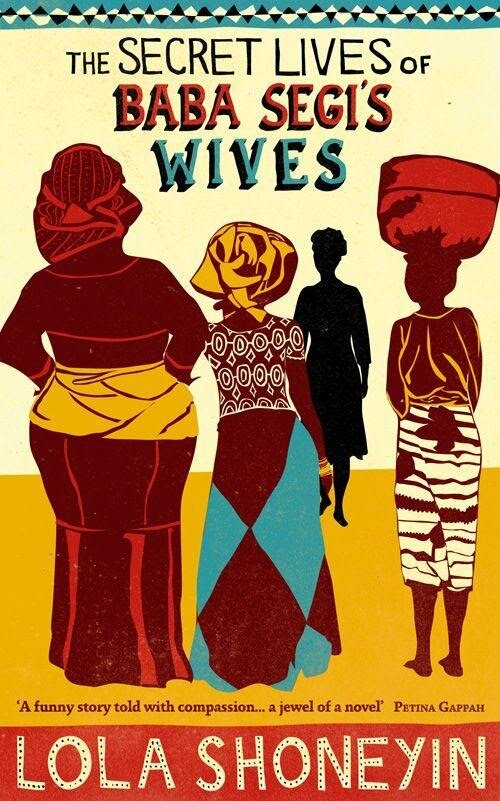
Book Review:The Secret Lives Of Baba Segi’s Wives By Lola Shoneyin

This month, we look at the superb book written by Lola Shoneyin- The secret lives of baba Segi’s wives. The readers are immediately introduced to the character of baba Segi as a man in a polygamous relationship. He has married three wives with seven children.

In the opening, the readers also learn that he took a fourth wife whom he has labelled as the “graduate wife”. He appears to be very boastful when he describes the fourth wife to his friend “teacher”. This shows that the other wives are uneducated.

The book showcases a marital power play where Iya Segi -the first wife- controls the household although baba Segi is the head of the house. Throughout the book, it can be seen how the rest of the two wives are afraid of butting heads with Iya Segi with the fear that she will ruin them.

A lot of secrets unravel in every chapter of the book which leaves the readers gasping for the next series of events. Each wife has a secret that baba Segi does not know about. However the truth always comes to light somehow. In this case, the fourth wife spinned the wheels in motion.

 Bolanle- the fourth wife- is described by the other wives as the evil one who came into the household as a hurricane to throw everything upside down and ruin the norm of the household. They wanted her out of the house by any means. There actions caused their downfall.  With the knowledge that the fourth wife cannot get pregnant, a visit to the hospital to sort out the problem is what started the end of their circus

Truly this book is quite remarkable, the language used by Shoneyin is quite relatable to the people living in West African, you can say that its indeed African. The author also touches on matters that face the society which include the problems of being uneducated. Some of the things done by the characters could be easily avoided if they were educated.

Grab yourself the book and have fun reading. Chances are you would not put the book down until you finish it.

By Vanessa Mwingira