

By Anne Tendwa
A conversation with spoken-word poet Pepita Mwanga about The Time Is Now and the Shasha Choral Project
What happens when poetry leaves the page and finds a new voice?
For spoken word poet, voiceover artist, lawyer and international development practitioner Pepita Mwanga, words have always been a way to connect, express and make sense of the world. Her journey with poetry began in primary school, eventually growing into a love for spoken word and performances on stages as far-reaching as the Scottish Parliament.
Now, her poem The Time Is Now has taken on a new life through the Shasha Choral Project — a cross-cultural collaboration bringing together voices, music and storytelling from Tanzania, Ghana, Nigeria and Scotland.
We sat down with Pepita to talk about her journey with poetry, the story behind The Time Is Now, and what it feels like to hear your own words transformed into music.

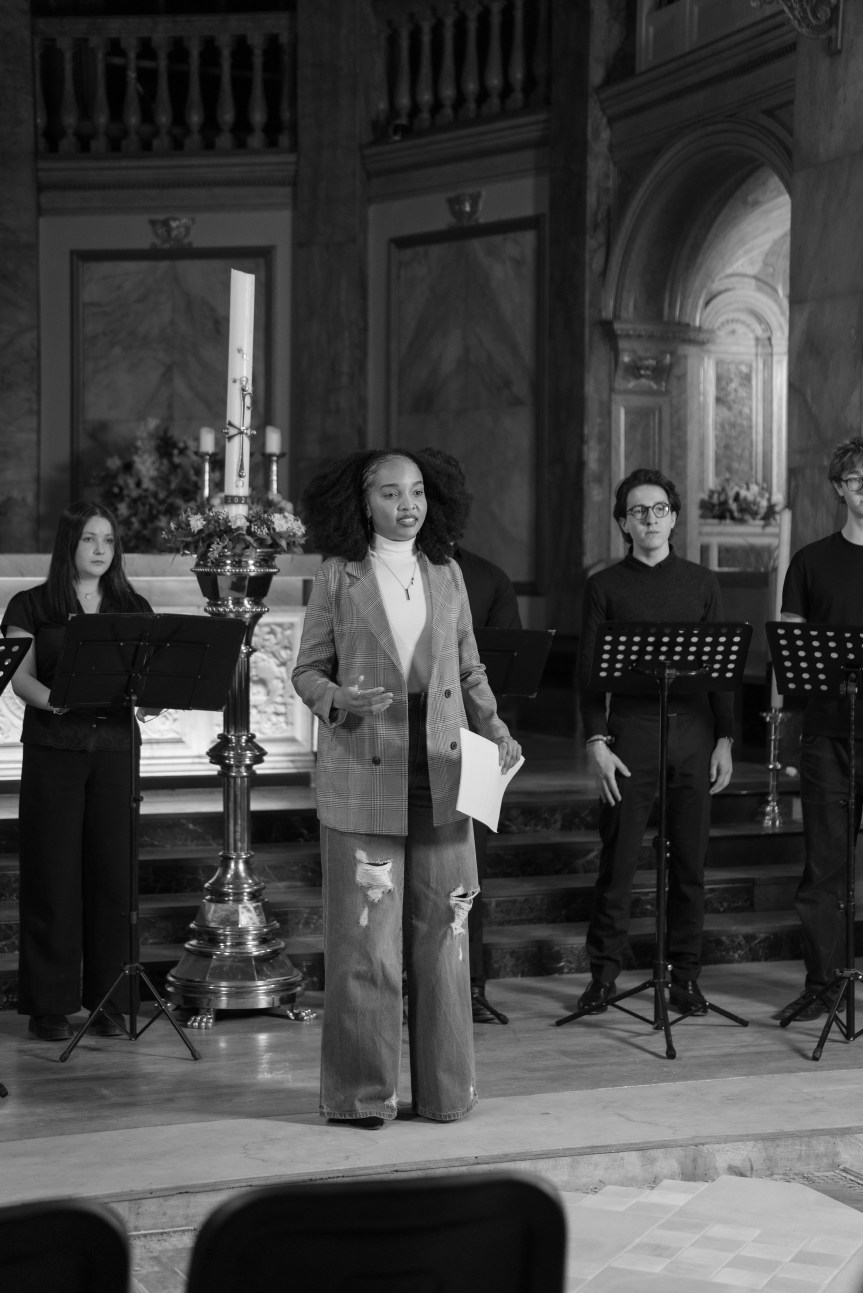
Pepita Mwanga — spoken-word poet, voiceover artist, lawyer and international development practitioner.
For those who are just discovering you, who is Pepita Mwanga? And how did poetry become such a big part of your life?
This depends on the context you find me in. I am a spoken word poet, voiceover artist, international development practitioner, and lawyer. That is a lot, I know. Welcome to my world!
My relationship with poetry started a long time ago, in primary school, where I won several awards for poetry recitations – performing other people’s poetry – before I began writing my own in secondary school. I naturally gravitated towards free verse because I wasn’t bound by formal rules, and that’s how the spoken word poet in me was born. I just thought it was fun to rhyme, and then it became a way to regulate my emotions. After the first performance of my own poetry, there was no looking back!
You’ve performed at some pretty amazing platforms, including the Edinburgh Fringe and the Scottish Parliament. What has been your favourite place or moment to perform your poetry so far?
Honestly, performing at the Scottish Parliament was an iconic moment – nothing beats that. But I really enjoy performing at home in Tanzania. I can move seamlessly between languages and fully express myself. Some jokes you can only make in Swanglish (Swahili & English).
Let’s talk about the Shasha Choral Project. For someone hearing about it for the first time, what exactly is the project, and how did you become involved?
The Shasha Choral Project is a cross-cultural creative initiative by the Shasha Network – a Scotland-based youth empowerment organisation. It translates raw human storytelling into a powerful, unified vocal performance. This musical collision is an invitation to urgency, and to showing up in the world as our truest selves. Our ideas, dreams, and imaginations are boundless and have the potential to bring positive change to the world, especially when we co-create, co-imagine, and work as a collective.
The founder of the Shasha Network, Farai Munjoma, is a good friend of mine, and when he had the idea for the project, he reached out to me and other poets for submissions. He wasn’t the one who selected the poem though, so it wasn’t favouritism (haha) – it was the two composers on the team, who didn’t know me, who chose my poem.
Your poem was written about three years before it became part of this project. What was going through your mind when you originally wrote The Time Is Now?
This poem was originally written and performed for the 2023 SDG Summit Curtain Raiser event. I wrote it as a call to action for the youth. The Time Is Now pulls the listener into the present moment, into the now. We often like to relegate things to later or wait for the stars to align before we act, but we will never have tomorrow. All we have is now. As a spoken word poet, I’m influenced by rhythm, and when I thought about the clock, it just came to me.
What was it like hearing your spoken-word poem transformed into music? Because that’s quite a jump — going from you performing your words to having an entire choir bring them to life!
It was very surreal. The interview videos for the project were filmed before the rehearsals and performance, so I didn’t know what I was in for. If they’d filmed those interviews afterwards, I doubt I could have held back the tears. Efua and Fraser – the two composers – did an amazing job, and the choir was fantastic. It took them only an hour to get it right; practice usually takes weeks! The whole time I was there, I felt like I was in a dream I never wanted to wake up from. And it happened in a church, which made the whole thing feel so divine.
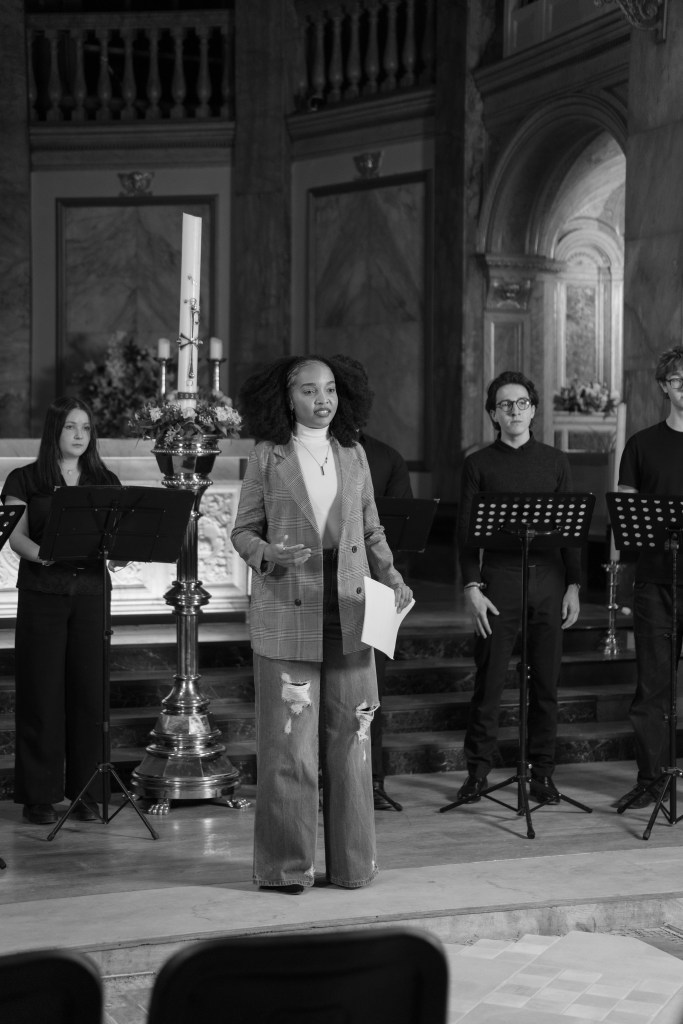
Pepita Mwanga performing The Time Is Now with musicians at the Shasha Choral Project.
One of the really cool things about the Shasha Choral Project is that it’s genuinely cross-cultural — your poem from Tanzania, music by Ghanaian-Nigerian-British artist Efua Agyare-Kumi, and composition and conducting by Scottish composer Fraser David Macdonald. What was it like being part of that mix?
It was amazing to be part of that mix. You could vividly see how the diversity enriched the collaboration – each person brought their own experience and background, and together they created something unique and beautiful.
The poem has this recurring sense of a clock ticking and a feeling of “we need to do something NOW.” Was that sense of urgency always the heart of the poem for you?
Yes and no. I really just wanted to pull the listener into the moment. I wanted the poem to be timeless – whenever you read it or listen to it, the time will always be now. Inevitably, a sense of urgency comes with that, and it worked well, so I leaned into it.
You’re a poet, but you’re also a lawyer and an international development practitioner. Do those different sides of you ever fight for attention?
Oh, yeah! It can be a challenge to make time for everything, but honestly, the grace of God carries me through it. I just go with the flow, truly. Embracing every side of myself has allowed me to fully express who I am.
Finally, now that you’ve seen The Time Is Now evolve from a poem into a full choral project and film, what’s next for Pepita? Are we getting more poetry, more collaborations, or are you keeping us guessing?
More poetry for sure! Stay tuned ☺.
From a poem written as a call to action for young people to a choral performance bringing together voices from across cultures, The Time Is Now has travelled further than Pepita Mwanga could have imagined.
And perhaps that is the beauty of the poem itself: we are always waiting for the right moment, while the moment is already here.
For Pepita, this may be one chapter in a much bigger creative journey. When we asked what comes next, her answer was simple: “More poetry for sure. Stay tuned.”
And if you want to stay tuned, you can follow Pepita Mwanga on Instagram at @apoetpepa, and follow the Shasha Network on Instagram at @shasha_network. You can also find the Shasha Network on YouTube, where you can watch The Time Is Now and discover more of their work.
Until next time, remember, the time is now.


